2026
Countfie Countdown Widgets
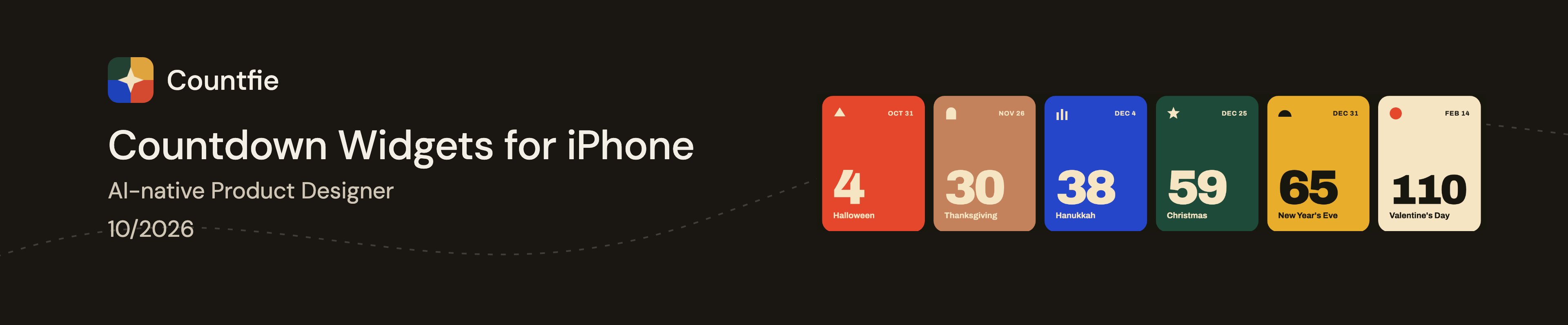
An iOS countdown app with Home Screen and Lock Screen widgets, live on the App Store since October 2026. I own all of it: niche research, UX/UI, design system, SwiftUI build, monetisation, landing and launch.
iOS · Widgets · Design System · Accessibility · Monetisation · AI-native build · App Store ↗
- Context
- Countfie is my own iOS app for counting down to the days that matter, with Home Screen and Lock Screen widgets, released for the holiday season.
- My role
- AI-native Product Designer: niche research, UX/UI, design system, iOS implementation (SwiftUI, WidgetKit), monetisation, landing page and launch.
- The Problem
- Countdown apps are a proven but crowded niche, and the holiday season is when people look for them. The bet: ship a calmer, account-free countdown app with holiday dates that are always right, in days, not months.
- Outcome
- Live on the App Store five days after the first commit. In the first days, 136 people visited countfie.com and 14 clicked through to the App Store. On day five after release, it had 40 users.
- Engineering
- I design for implementation and build it myself: SwiftUI, WidgetKit and App Intents, widgets in every size, live timers with Live Activities, local notifications.
- Date logic as a product problem: 46 event templates with date rules (Easter via the computus algorithm, moving holidays, date tables up to 2030), covered by tests.
- Accessibility in code: text colour on every background is picked automatically for WCAG contrast, with contrast tests for every theme.
- Monetisation: a free first week, then a paywall with 3 products in RevenueCat (monthly, yearly with a trial, pay once).
- Landing page and SEO pages (Vite, Vercel), localised in English and Polish.
- Working with AI
- Claude Code is my daily partner for building, debugging and research.
- I run agents in parallel: implementation, audits and market research.
- Pace: from the first commit to the App Store in five days.
- Tools
- Figma: mockups, design system, components with variants, App Store screenshots. FigJam for SEO brainstorming.
- MCP servers: Figma (design to code), AppMonkey (market and competitor research), PostHog, Notion, Vercel.
- PostHog for the onboarding and paywall funnel, RevenueCat for purchases, Notion for the launch checklist.
01 · Research and the niche
Is there room for one more countdown app, and when is the right moment to launch it?
- A proven niche: AppMonkey estimates put the category leader at about $770K a month, so the demand is real.
- Launch timed for the holiday season (Thanksgiving, Christmas), when people search for countdowns. Everything that didn't block the submission moved to version 1.1.
- Utilities as the primary category, where the countdown leaders and their charts are, and Lifestyle as the secondary one.
Result: A dated, narrow scope: first commit on 16 Oct 2026, live on the App Store on 21 Oct, five days later.
Built with: AppMonkey · Claude Code · Notion
02 · Product and UX
A countdown app is only useful if the first countdown is set up in seconds.
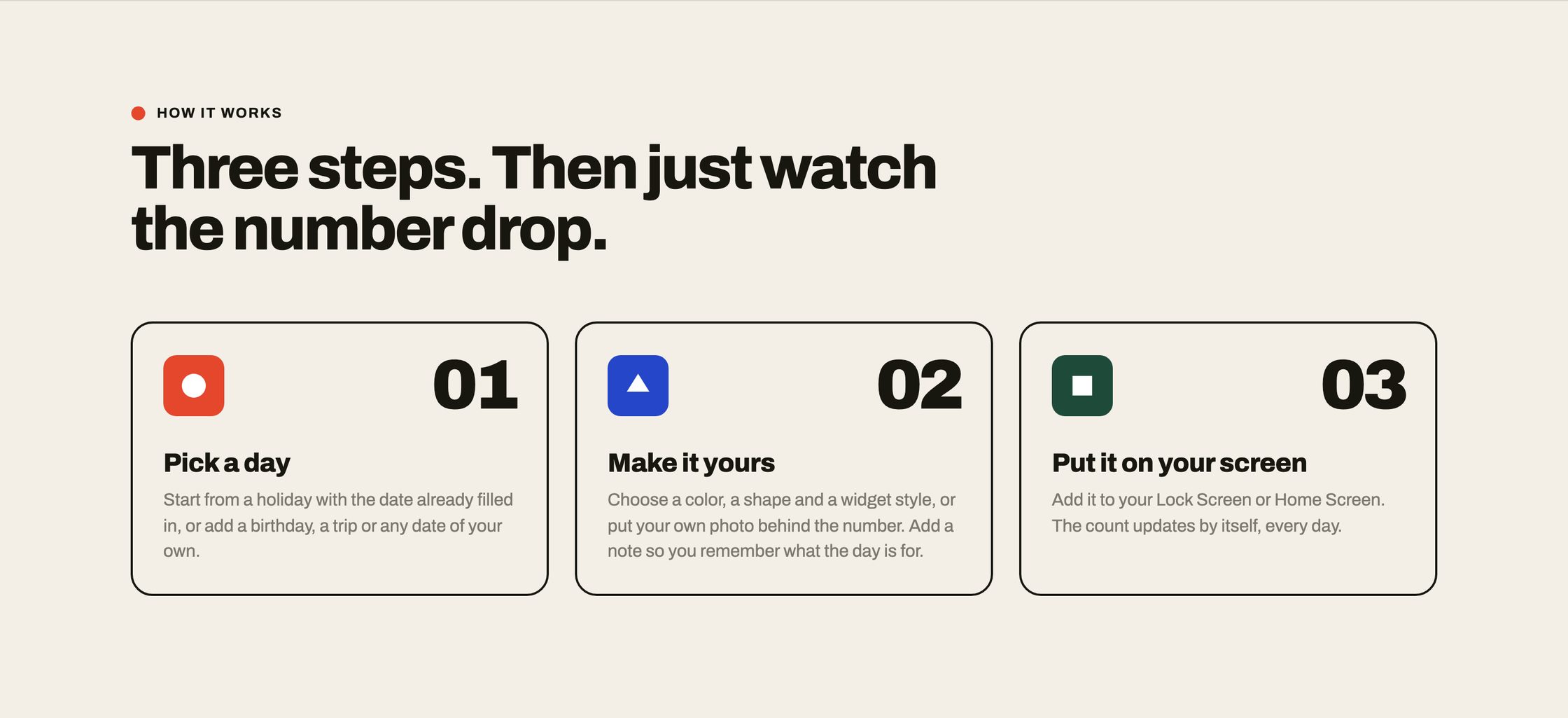
- No account. Onboarding is three screens: the value, a first event from templates, and how to add the widget.
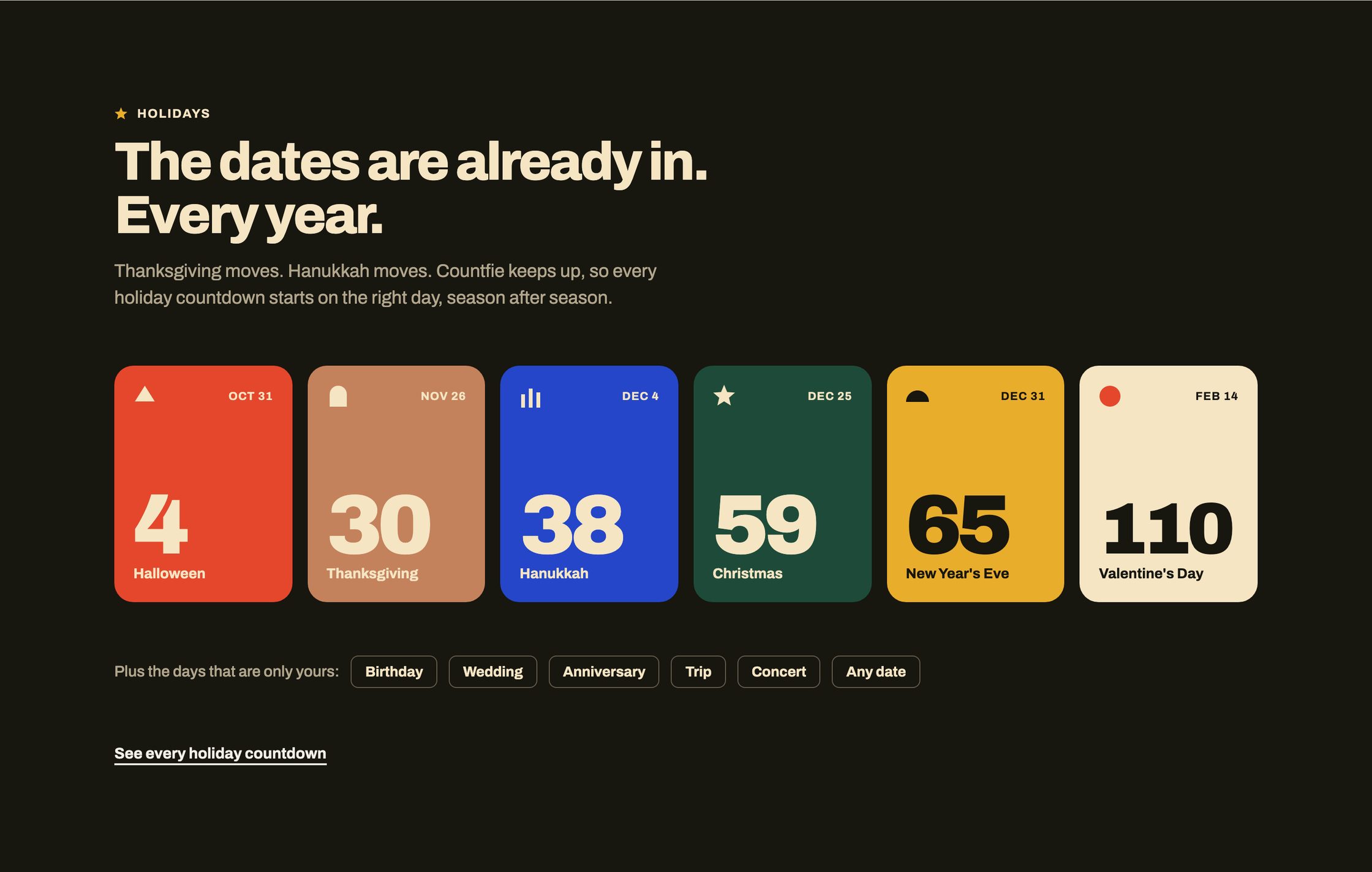
- Templates first: holidays come with the right date every year, so most countdowns take one tap.
- One simple flow for the rest: a home with big day numbers, details with a progress bar, an editor and a share card for Stories.
Result: 86% of people who started onboarding finished it (25 of 29), 69% created a countdown and 48% put a widget on their screen. PostHog, as of 28 October 2026.
Built with: Figma · SwiftUI · Claude Code
03 · The widget system
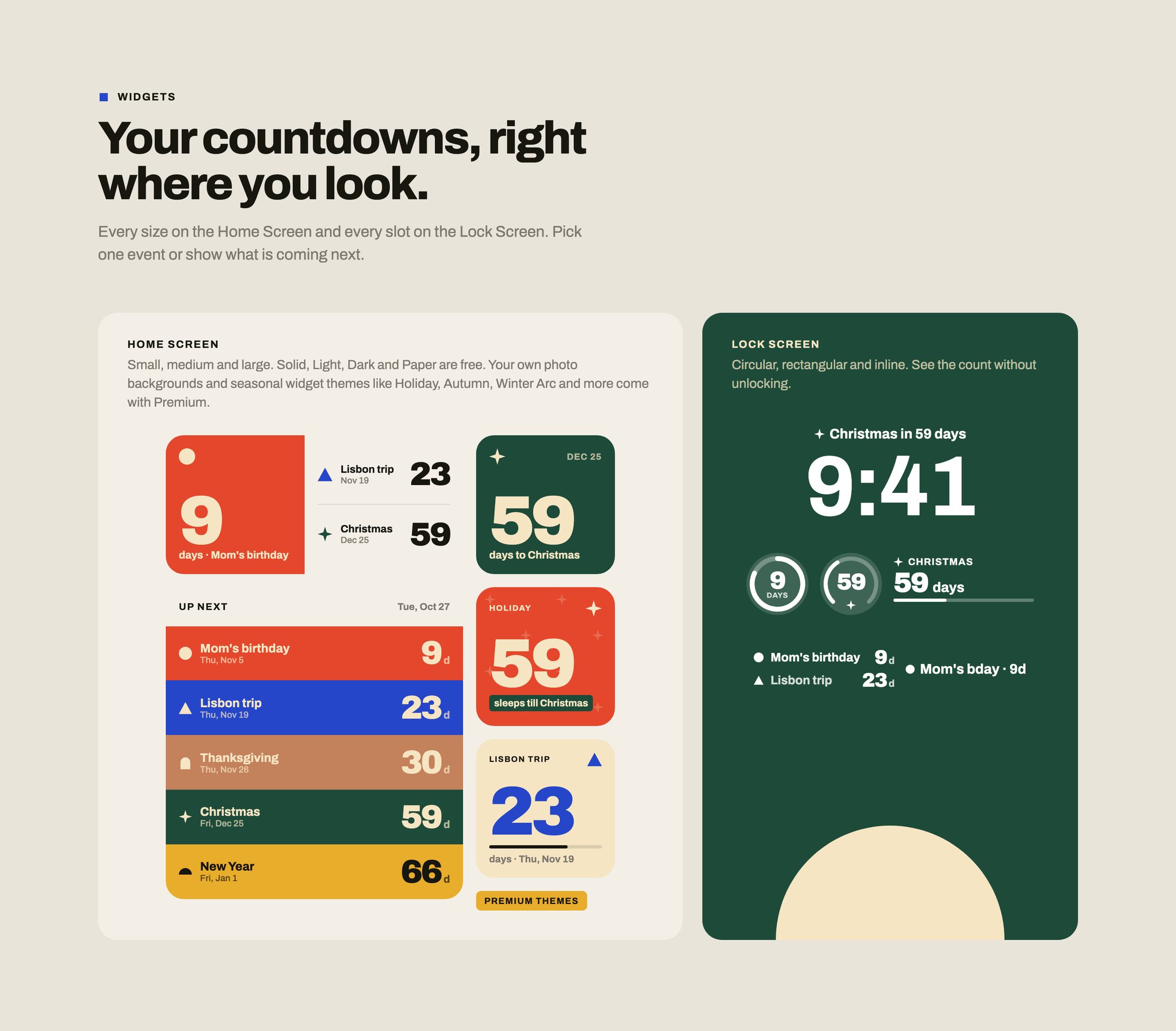
The widget is the product: it has to look right in every size and on every wallpaper, free or paid.
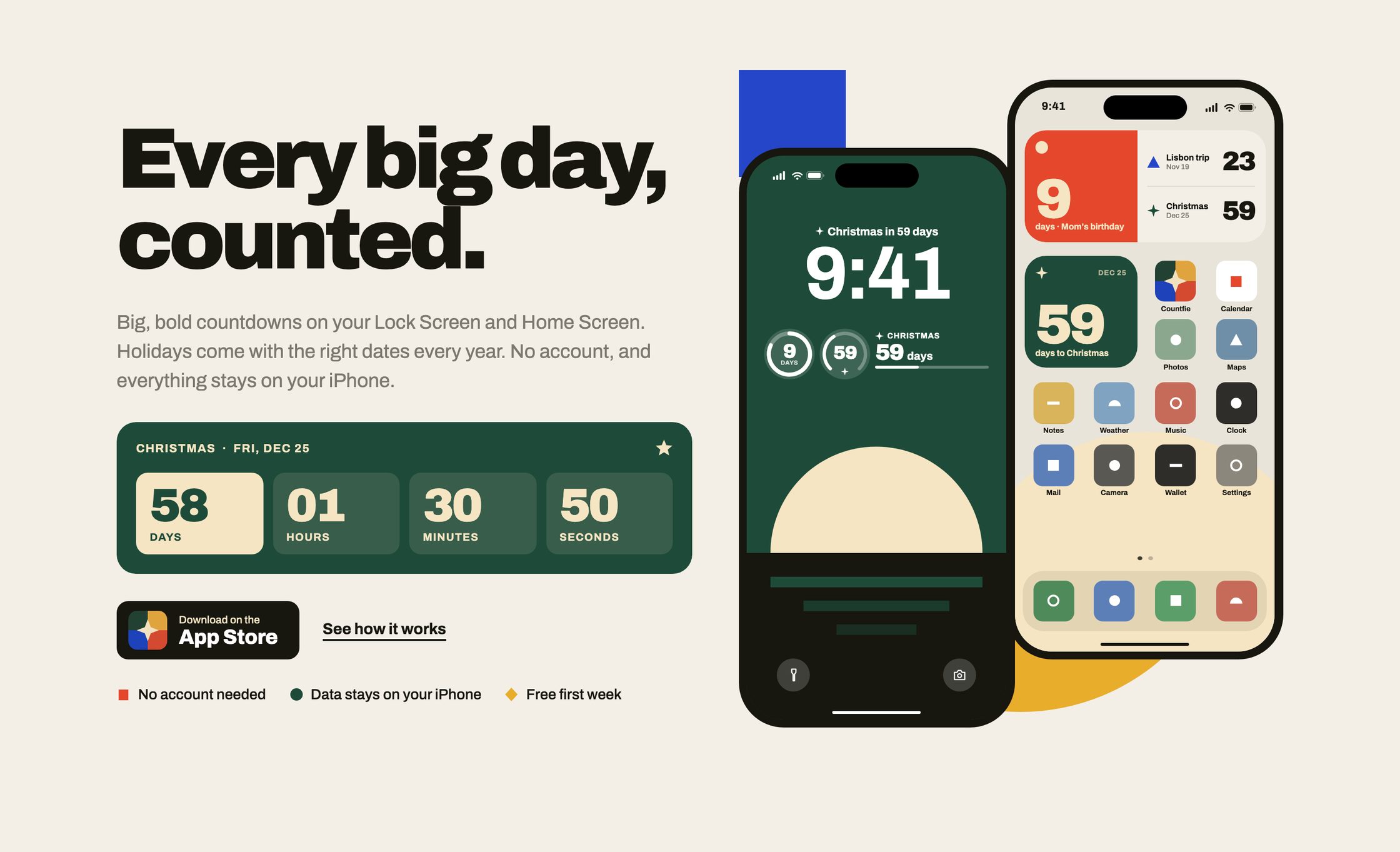
- Six sizes from one system: small, medium and large on the Home Screen, circular, rectangular and inline on the Lock Screen.
- Free themes (Solid, Light, Dark, Paper) and Premium ones (Holiday, Bubblegum, Autumn, Winter Arc, Photo). A Premium style without Premium falls back to Solid.
- Photo backgrounds through the system photo picker, so the app never asks for access to the photo library.
Result: 6 widget sizes and 9 themes from one style system, plus 3 live timer widgets.
Built with: WidgetKit · App Intents · Figma
04 · Accessibility
Every countdown can be any colour, so readable text can't depend on someone checking each combination by hand.
- Contrast is a rule of the system: the text colour on each background is chosen automatically, cream or ink, whichever contrasts more.
- Secondary grey darkened from #7D786D to #6B665C to reach 4.5:1 on paper, chips, white cards and cream.
- Colours that drop below 3:1 on Paper or white fall back to ink, and contrast is covered by tests for every theme.
Result: WCAG contrast is checked in code for every theme and colour, not fixed by hand.
Built with: SwiftUI · Swift Testing · Claude Code
05 · Monetisation
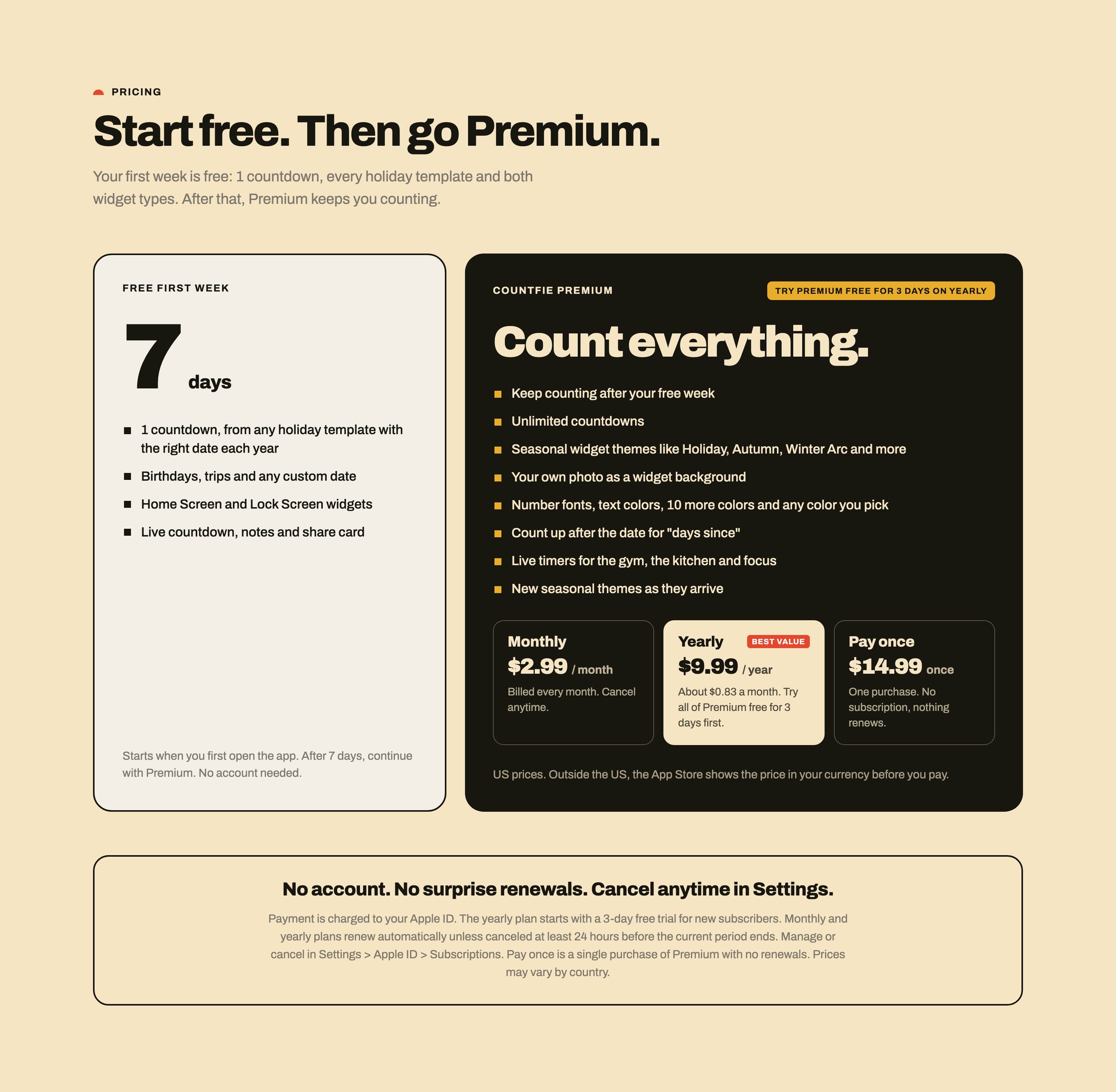
A countdown app with a subscription is a grey zone for App Review, so Premium has to give ongoing value.
- A free first week: 1 countdown for 7 days with every holiday template and both widget types, then a paywall.
- Three options in RevenueCat: monthly ($2.99 / 14.99 zł), yearly with a 3-day trial as the default ($9.99 / 39.99 zł) and pay once ($14.99 / 59.99 zł).
- Premium as ongoing value: new seasonal themes and templates as they arrive. The one-time option is called “Pay once”, never “lifetime”.
Result: So far, 2 people are on a free trial, on the way to paying.
Built with: RevenueCat · PostHog · Figma
06 · Launch
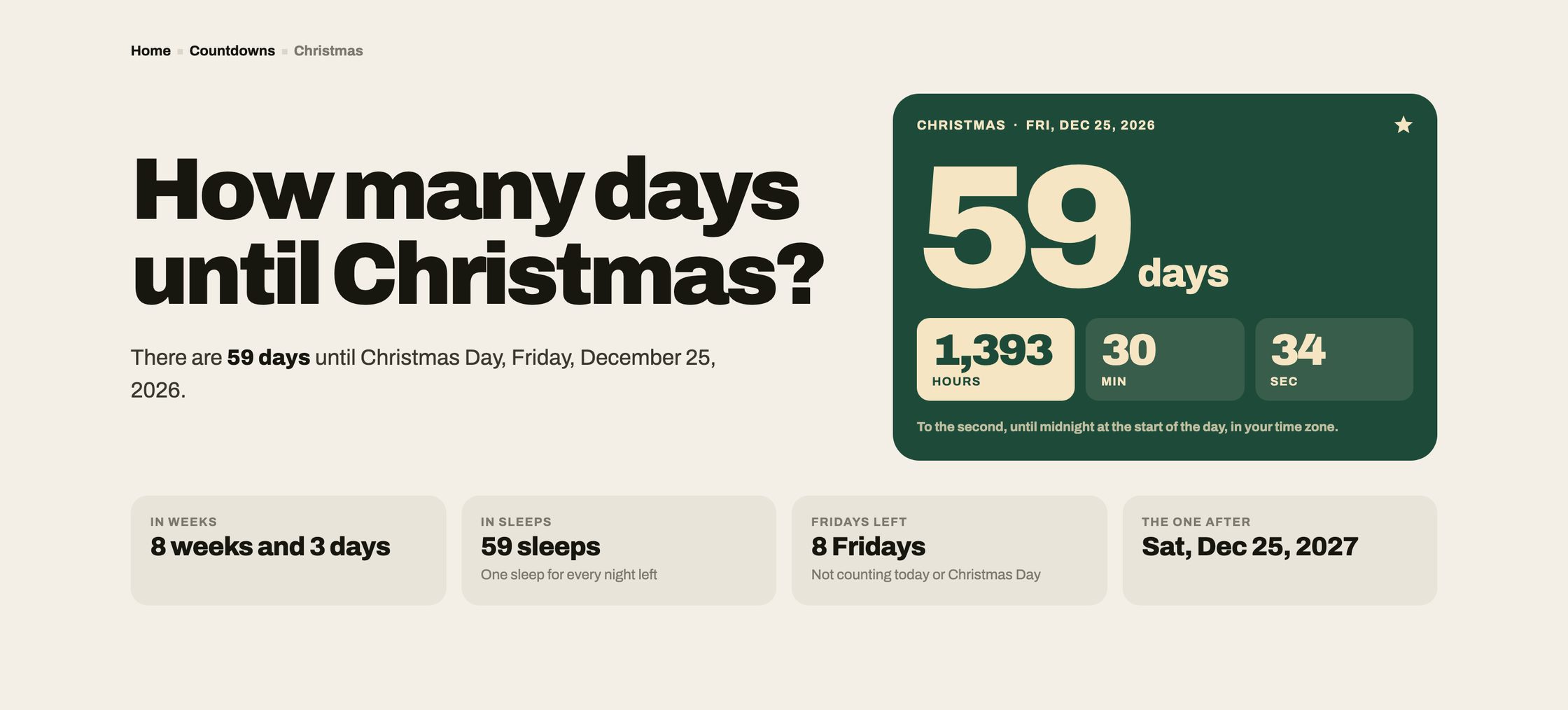
People search for “days until Christmas”, not for app names.
- SEO pages for the big days (Christmas, Halloween, Hanukkah, New Year, Thanksgiving, Valentine's Day) with a live countdown that leads to the app.
- A landing page on Vite and Vercel in English and Polish, with privacy, terms and support pages.
- Analytics from day one: PostHog events for onboarding, templates, the paywall, purchases and widgets.
Result: Live on the App Store since 21 Oct 2026, with the landing page and 6 SEO pages at countfie.com. 40 users on day five after release.
Built with: Vite · Vercel · PostHog · FigJam
07 · Studio ops
After launch, the job is checking the numbers every day, so I built a separate admin panel for it.
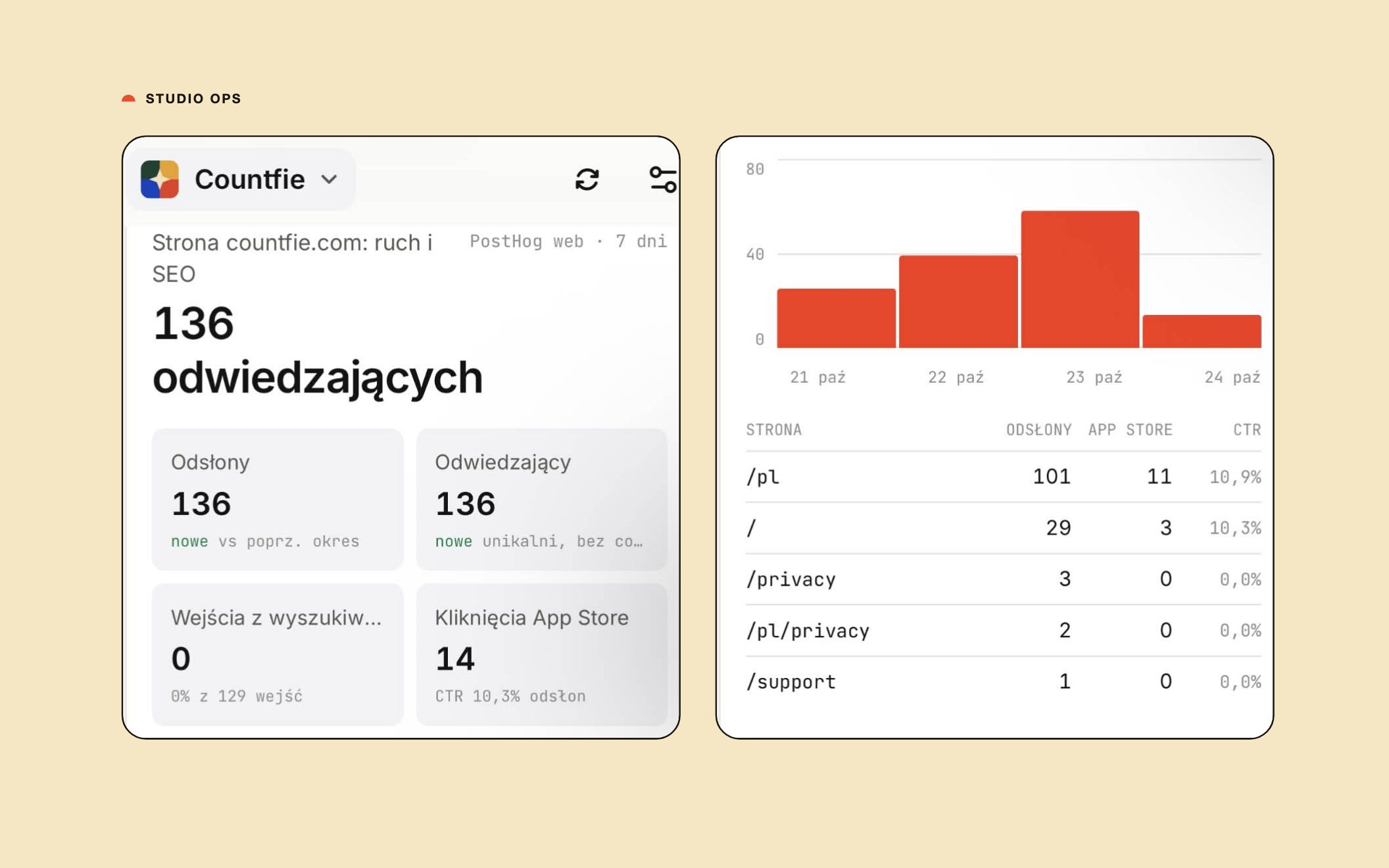
- Studio ops pulls data through API keys from App Store Connect, PostHog and Meta Ads into one place.
- Every day I check two things: whether any of them reports errors, and where website traffic comes from, search (SEO) or ads.
- Each page of countfie.com shows views, App Store link clicks and click-through rate, so I can see which page sends people to the store.
Result: first days after launch (21–24 Oct): 136 visitors on countfie.com and 14 App Store link clicks, 10.3% of page views. Three quarters of the views went to the Polish page, and none came from search yet.
Built with: App Store Connect API · PostHog API · Meta Ads API
08 · First reactions
Before the numbers, I asked people directly: a call for testers in a Facebook group for women, and messages after their first try.
- Within a day, several people in the group offered to test it, and one wrote that with her bad memory it would come in handy.
- One asked for an Android version, the first signal of demand outside iOS. I logged it for later instead of building it now.
- Messages after the first try praised the visuals (“great graphics, I really like it”) and the need itself (“I was looking for something like this”).

09 · Next: talking to users
The numbers show what people do. To learn why, I'm starting contextual interviews.
- Recruiting inside the app: a short prompt will ask for 15 minutes of the user's time in exchange for a year of Premium.
- Goal: 5 contextual interviews with people who already use Countfie.
- What I want to learn: what happens at the paywall, and whether the app gives enough value to pay for.
10 · Takeaways & Next Steps
Live on the App Store since 21 October 2026, five days after the first commit and in time for the holiday season. In the first days, 136 people visited countfie.com and 14 clicked through to the App Store. On day five after release, it had 40 users. Now I'm focused on the key product metrics: PostHog and Google Search Console show where to grow, and Meta ads test which audiences actually convert. First numbers from PostHog (as of 28 October 2026): 86% finish onboarding (25 of 29), 69% create a countdown, 48% add a widget, and 2 people are on a free trial.
Next: grow it on data and on conversations with users. Five contextual interviews, PostHog for the onboarding and paywall funnel, Google Search Console for the SEO pages, Meta ads to validate the target audiences. On the product side: version 1.1 with pause and resume right from the Live Activity, new seasonal themes and templates, and date tables beyond 2030.